Whistler
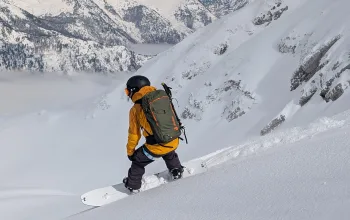
Over the past 20 years no resort has hit the winter sports world headlines as often as Whistler in British Columbia. Coming from way down the world rankings the resort shot to the top of the reader survey popularity charts in North American consumer ski magazines in the early '90s, and has stayed there ever since. Not only a North American phenomenon, Whistler has pulled in package tour operators from all over the world by the dozen in recent years and topped 'favourite foreign resort' polls in countries like Japan. Whistler hosted most on-snow events (except snowboarding, ski-cross and frestyle) at the 2010 Vancouver Winter Olympics, fulfilling its creators dreams 50 years earlier of creating a resort to host the Olympic Games. It now attracts more skiers and 'boarders than any other resort on the North American continent. The resort began life as recently as 1966, with its 'municipal inception' a decade later. Since then an incredible 2.7 billion Canadian dollars have been spent making the resort what it is today. The reasons for the unprecedented enthusiasm in Whistler today are many. Perhaps you start with the fact that North American ski resorts are recognised as having the best service standards and lift systems in the world, then you consider that Whistler has the best lift system in North America, with the most high speed lifts in the world. Secondly you might add in to your musings that Whistler has not one but two mountains, Whistler and Blackcomb, lift-linked together, providing the biggest ski area in North America. Oh, and these two mountains also have one-mile of vertical, which is some of the largest lift accessed terrain in North America. Indeed the 'Blackcomb' effect can't be overstated. Originally developed by Intrawest in the mid 1980s, their first major ski resort project, it provided valuable competition for Whistler mountain for well over a decade before the two came under joint Intrawest control. Whistler is big enough to ensure a vast range of choices on and off the slopes when you're not riding up and sliding down the slopes - around 100 restaurants and 200 shops plus a huge choice of accommodation (more of it slopeside than anywhere else in North America) and activities. Finally there are little things like the proximity to a major international airport; the favourable exchange rate of most countries, including the US, to the Canadian dollar; the status of having the only lift-served summer glacier skiing in North America; the uncrowded slopes; the vast choice of terrain. Of course the residents and fans of Whistler will tell you that these are just the ingredients, and it's that 'something else', the feel of the place, that makes it truly great. The only negative factor that any critics, desperate to find a flaw in the apparently nigh on perfect ski resort, can find, is that its low elevation and proximity to the Pacific can mean rain rather than snow at base level at each end of the season. Whistler's view is that the low base is a boon because, although they have some of the biggest verticals in North America, the top elevation is not as high as resorts in Colorado, so altitude sickness is not a danger for Whistler's guests. The proximity to the coast also means that it doesn't get overly cold - just cold enough for an average 33 foot dump of powder each season.
|
Saariselkä
Saariselkä is a popular year-round holiday village which offers a unique selection of activities to visitors. It is located in the "heart of Lapland," a semi-autonomous region which stretches across northern Scandinavia and is home to the Sami people. The resort is in the province of Ivalo on the eastern side of Finland, which continues on to the Russian border. Saariselkä is the northernmost winter sports centre in Finland, 250 km (approx. 160 miles) above the Arctic Circle and a similar distance from the Arctic Ocean to the north. This makes it Finland's and one of the world's most northerly ski resorts. But it is conveniently located just 20 minutes drive from Ivalo airport. Most visitors find the vast wilderness area surrounding the resort stunningly beautiful, with low hills or fells covered in pine forest frozen in suspended animation by temperatures which typically hover a few degrees below zero in the winter, although they can drop to 20 or 30 degrees below. The locals are well prepared for such cold temperatures however, with thermal wear loaned out and a lovely snug feeling once you're indoors. The clear 'blue light' and horizontal winter sunshine is particularly magical. The sense that the wilderness continues on, uninterrupted, up toward the North Pole, gives an exciting feeling of being in a very different type of ski resort to the typical Alpine village for many guests. The area has a higher population of reindeer than people and again most guests enjoy meeting these peaceable creatures. Saariselkä is within the Urho Kekkonen National Park named after Finland's former president. It was once home to legions of gold panners after the precious metal was discovered in the Ivalojoki river, the huts they built are still to be seen in a few remote locations. The first gold claim in Saariselkä was made in 1871 and the first gold rush began. At the turn of the 19th and 20th centuries a second, larger gold rush began and Saariselkä came in to being. In 1902 the Prospektor gold mining company began work to cart trail from the resort and the first cars arrived in 1914. Development as a tourism destination is relatively new with the resort planned in the mid-1960's and the first modern restaurants and hotels opening in the 1970s. In 1978 Kiilokappeli-chapel was built and the National Park was created on May 5th 1983. Given the northerly latitude there is of course a good chance of seeing the northern lights. With short winter days those chances are even greater. In common with other northern resorts, downhill skiing and boarding is one of a selection of winter sports and activities available but not the dominant one. Guests are equally likely to go snowmobiling, cross-country skiing, snowshoeing or dog sledding as downhill skiing. Indeed cross country skiing is far more popular. Saariselkä itself is made up of low lying hotels and other buildings, varying between cosy little shops and cafes to a few giant eateries and nightclub that are the norm in Scandinavia's major resorts in order to accommodate sometimes big lively get togethers. British winter tourism to Saariselkä has been organised by Headwater Holidays (www.headwater.com) for several years and is now also offered by Inghams.
|
Alpbach
An ideal beginner resort oozing Tyrolean charm and voted the most beautiful village in Austria by Austrians themselves in 1983 and then awarded 'most beautiful flowering village in Europe' status a decade later by an international Jury during the 'Entente Florale' competition. Alpbach is located in one of the valleys that runs off the main River inn valley, 57km (36 miles) east of the Tyrolean capital, Innsbruck. Alpbach's natural beauty, apart from the generosity of mother nature, can in part be attributed to Alfons Moser, the mayor for more than 30 years from 1945 to 1979. He ensured as early as 1953 that local building regulations insisted that all new construction was completed in the traditional Tyrolean architectural style. The village's 2500 year history has therefore not been compromised by modern development, which includes an excellent indoor pool complex. The oldest houses are in the neighbouring community of Inneralpbach, linked to the skiing of Alpbach and is 4km away. It is a quiet, ideal beginner resort. The area's rich history is well documented. It was christianised in the 8th and 9th centuries by monks from Ireland and Scotland. St Oswald, the former king of Northumbria in England, is patron saint of the village church, which has a steeple dating back to 1440 and a nave to 1754. Copper and silver were discovered in the 15th century and mining continued for more than four centuries, after which farming became the dominant industry until the advent of tourism in the 1930s. This began after the first road reached the resort in 1926 and by 1938 there were 110 guest beds. Although this number has now increased to more than 2700 beds - still a modest figure by modern standards - the resort is clearly proud that it still has just over 100 farms operational, just as a century ago. Because of its isolation until the first half of this century Alpbach has many unusual local 'twists' on traditions, a lot of which survive to this day. Locally produced farmers and miners furniture is still evident and highly sought after by collectors. A local brandy was until recently, produced in one of the five old miner's houses in the village, two of which remain inns, as they were several centuries ago. Among its many claims to fame, Alpbach hosts the European Forum annually when groups of thinkers from all over Europe come together for discussions. Established at the end of the war in 1945, the forum has attracted personalities from the worlds of politics, economics, science and culture for the fortnight long convention. The staging of this annual event was a major factor in the awarding of the European Flag in 1985 by the Europarat organisation in Strasbourg. The resort's international status away from winter sports doesn't end there, the convention centre is named after Paula von Preradovic, who wrote the lyrics for the Austrian National anthem whilst the large lecture hall is dedicated to Professor Erwin Schrödinger, a Nobel prize winner who is buried in the local church yard.
|
Grandvalira
Half a dozen of Andorra’s ski villages, including the best known resorts of Pas de la Casa and Soldeu, share a common ski area called Grandvalira. This is the name by which the ski resort prefers to be known – like a giant French resorts such as La Plagne and Les Arcs – one ski area with ,multiple base villages; however decades of being separate ski resorts mans many people still call the area by individual resort village names like Pas de la Casa and Soldeu. But however important the name may seem to marketing people, the reality is that the experience is the same. Whichever village you stay in you’ll have access to a very big ski area, indeed now one of the world’s 50 largest as well as the biggest in the Pyrenees, and with some of the planet’s most up to date lifts too. These now straddle the border in to France as well as taking up a large swathe of North Eastern Andorra itself. The different villages are of course of different sizes and have different facilities, but the lift pass issued at each covers the full ski area between them all. Andorra itself is a tiny duty free principality in the southern Pyrenees. It’s a country ideally suited to snowsports with its high snow sure mountains and almost Mediterranean. Its ski areas have seen constant development for many decades, growing from “Cheap and cheerful” in the 1970s and 80s to be increasingly sophisticated in the 1990s and since 2000 with modern lift infrastructure, ever expanding ski areas reaching world-class dimensions and resort bases moving up market. Grandvalira came about in 2004 when the previously fiercely competitive resorts of Pas de la Casa and Soldeu, which had spread their ski areas across the mountains to meet each other, finally buried the hatchet and became a single ski area – Grandvalira. It has six key bases or access points, including Pas de la Casa, Soldeu, El Tarter, Grau Roig, Canillo and Encamp. The largest of these is Soldeu which sits between Pas de la Casa and El Tarter. Soldeu is a typically lively, high value, friendly Andorran resort with a larger than average ski area. The biggest investor in skiing in the Pyrenées during the 1990s, the resort added a new eight seater gondola for the 1996/97 season and new hotels. Then for 1999-2000 the resort again made a huge investment with three new six seater chairs together with a second eight seater gondola. It continues to invest as part of Grandvalira today. Soldeu is a modern, dynamic resort set in dramatically picturesque surroundings. First rate for bumps and moguls - Soldeu is a regular venue for freestyle mogul comps. The base at El Tarter is more traditional and many visitors choose to stay in the town of Canillo, 4km (2 miles) down the valley which has the lion's share of the 'off slope facilities' in the area. Access to the resorts is simple with the Funicamp (mountain cable car) making the journey from Encamp, Andorra's most central village, in 14 minutes up to the slopes - a journey which would previously have taken four times as long on a winding mountain road. As well as being one of Andorra's most popular ski resorts Pas de la Casa is also a border town - the gateway into the country from France. The name Pas de la Casa (literally Pass of the House) derives from the days when all you would have found there was a shepherds' hut which served as a landmark for travellers crossing the River Ariege. Nowadays it is a busy border control manned by customs officers checking on the numerous visitors who come here either solely for the duty free shopping or to enjoy the variety of snowsports on offer. It is popular with the young French and Spanish too who frequently make the border crossing to enjoy the unrestricted nightlife in this unique Catalan snow-filled Tijuana. The skiing at 'Pas' was first developed in 1957 by Francesco Viladomat, a local businessman, it started with only one draglift and gradually grew with more lifts introduced every year. Until 1976 the station was on one mountain only, the Peak of Envalira; by the 1980s it had spread to Monmalus and the Peak of Cubil up to the area of Cercle de Pessons and the Cortals d'Encamp. Until the 1950's Andorra's economy centred mainly on the summer pasturing of sheep and cattle and the harvesting of tobacco, rye, olives and grapes while industry was limited to processing these products and the production of handicrafts. Since then tourism has taken over as Andorra's main source of revenue, exploiting its scenic mountains and recognising the massive potential for wintersports. Due to the lack of customs duties and low or non-existent taxes, Andorra has become an important international centre of retail trade attracting millions of shoppers from all over Europe to its duty free haven. The 1990's brought dramatic changes to Andorra and its massive financial investments have brought Andorra's sports facilities, both on and off the mountains, firmly into the 21st century.
|
Superdévoluy
Sunny, high-rise purpose-built centre with direct-to-snow access from all lodging, it is lift linked to La Joue du Loup. SuperDévoluy has a quiet vibe and is perfect for families, not for partying. There's a good skier/boarder mix, prices are good compared to much of the Alps, it's not posh and not for serious big mountain fans or powder perfectionists.
|
Alpe d'Huez
One of the world's major ski centres, the Grandes Rousses ski area above Alpe d'Huez is a huge and high domain served by an extensive lift system. The resort itself is one of Europe's highest and largest with a massive vertical drop, crowned by the Sarenne Glacier. Built above the original village of Huez, the resort has expanded in all directions over the past 20 years. Today the resort is big and vibrant with far more shopping and 'things to do generally' off the slopes than in most other ski centres, especially by French standards. Architecturally the place is a mish mash of traditional Alpine chalet style wood and stone buildings, some rather ugly rectangular concrete developments and one tasteful modern construction. There are two huge beginners areas directly above the resort and those going on to the top of the lifts will be able to see a fifth of France, on a clear day, from the top station. The resort has a reputation for both good snow falls and good sunshine with south facing slopes - the areas protected by 900 snow cannon. Alpe d'Huez is one of the most southerly located major international resorts in the French Alps.
|
Borovets
Borovets is the oldest and the biggest mountain resort in Bulgaria, well known internationally, in part because of the excellent value it offers compared to other top resorts around the world. Virtually all of the major mass-market international tour operators are here. Borovets is known also as a good place to start skiing in a fun and unintimidating atmosphere, with a highly regarded ski school and without risking a huge spend on something you're not sure you're going to enjoy. The resort does, however, have some expert skiing and a specialist advanced-level ski school to help you make the most of it. Another selling point is the lively and varied nightlife, again fired on by the low prices and exuberant atmosphere. The downside of Borovets can include varied conditions on the piste. Although the north facing slopes have some of the best snow conditions in Eastern Europe this is not always comparable to the Alps. Some visitors have also complained of unhappy experiences in their accommodations and the restaurants, although many report the opposite. Established at the end of the 19th century as a hunting centre for the former royals of Bulgaria, Borovets has gradually developed into a modern ski centre with a wide range of accommodations. Fortunately most of its growth in the modern era has not been too disastrous, with the large hotel complexes generally shaped rather than rectangular, sometimes wood clad and always set within the forest. The resort is situated at 1350m above sea level on the northern slopes of the Rila mountains among ancient pine woods. The local mountain, Moussala (2925m) is the highest on the Balkan Peninsula. It's an easy resort to reach, only 73km (45 miles) from the capital Sofia. The nearest town of Samokov is 10km (6 miles) down the road from the resort. Visitors to Borovets should take a few practical steps to counteract local practical instabilities and uncertainties. You should also take your money in hard currency, such as US dollars, as Eurocheques, travellers cheques and credit cards are not widely accepted. Where credit cards and travellers cheques are accepted there's usually a heavy surcharge of around six per-cent on average. Non mainstream currencies and, for example, Scottish sterling bank notes or torn or damaged money are not welcomed. Many visitors will find they need a visa to enter Bulgaria and should check on this prior to travel.
|
Chamonix
One of the few serious contenders for the title of "World's Most Famous Ski Resort", Chamonix Mont Blanc (as the resort prefers to be known) has the world's biggest lift-served skiable vertical drop of 2807 metres ( 9209 feet ), one of the world's longest runs through the Vallée Blanche at 22 km ( 13.7 miles ) and staged the World's first Winter Olympics in 1924. Beyond these spectacular statistics is Chamonix's relatively undisputed status as the world's tough mountain sports capital, the subject of endless ski magazine reports each season from editors wishing to prove they descended between the glacial crevasses and lived to tell the tale! For lesser mortals there are plenty of on-piste kilometres to soak up, all dominated by the spectacular scenery of Mont Blanc, Western Europe's highest peak (and Europe's second highest after Mt Elbrus in Russia, although some dispute whether Elbrus is in Europe). Chamonix's history has been traced to Bronze Age times and its current status was confirmed in a report as far back as 1751 when the locals were described as "the most uncompromising men in Europe". Ten years before that Englishmen William Windham and Richard Pococke had been on the first recorded tourist trip, reaching the Mer de Glace. The first skis in the valley were spotted in 1893 and by 1907 one of the world first cable cars, 'Les Glaciers' was in operation (since removed). Six more were to follow between 1927 and 1963. The Mont Blanc Tunnel opened a few years later ensuring first rate access infrastructure in to the future. Chamonix Mont Blanc itself is a lively town with its own character, not just one created every winter season and reinvented every summer. That character reflects the attitude of its residents and of most visitors - a true love of the mountains.
|
Alta Badia
Alta Badia is a pretty Italian area that includes the villages of Corvara, Colfosco, La Villa, San Cassiano, Badia and La Val make up the Alta Badia ski area in the Dolomite region of Italy's South Tyrol. Franz Kostner, a famous mountain guide, was the pioneer of modern tourism in Val Badia. At the end of the 19th century Franz and his brother Ojop climbed many famous peaks including some in the Himalayas. On his return to Val Badia he saw all the possibilities for tourism in the area and started by founding the "Automobile Company" - before then Val Badia was only accessible on foot or by horse-drawn coach. In 1908 along with his wife Ottilie, Franz Kostner opened the first hotel in Corvara, the Posta Zirm which today has one of the most popular night spots in the village - the Taverna Posta. Alta Badia is linked to the Sella Ronda - one of the most famous ski tours in the Dolomites - which has famous skiing valleys radiating off it like spokes from a wheel with almost all of them lift-linked. The Sella Ronda runs around the Sella Massif - a vast, vaguely square shaped mountain of rock that juts out of the earth with jagged sides. Its spectacular to look at but difficult to cut a piste through so there are gentle trails leading around the gently sloping base, the circuit of which is some 25km (16 miles) long and possible to complete in a day. The Dolomites take their name from the French aristocrat and geologist Déodate Guy Silvane Tancrède de Grandet, Lord of Dolomieu. He was born in 1750 in an age when science, exploration and discover were highly fashionable. Dolomieu explored the mountains of Italy, Tyrol and Graubünden but whilst in the South Tyrol he discovered a type of mineral consisting of calcium magnesium carbonate, the main component of the renowned 'pale mountains' which were eventually named after him. The First World War was devastating for Val Badia and the other Ladin valleys. For 4 long years, the Dolomites were the scene of bloody conflicts and battles which ended in the deaths of thousands of soldiers on both fronts. It was above all a war of position where surviving the adverse climatic and living conditions were added to the continuous struggle. The routes and scars of those battles, which had their most hard-fought fronts in the Col di Lana, Tofane and Marmolada, are still recognisable in the Dolomites. At the nearby Marmolada there is a museum to the history of World War 1 in this area and a model of the ice town which was built in the glacier by the elite Austrian mountain troops, the Kaiserjager. The "ice town" was an 8 mile labyrinth of tunnels and trenches carved in ice and rock by the troops and lived in by many soldiers between 1916-17. This incredible feat of engineering is slowly melting as it becomes visible, but other remnants of the era are now the targets of souvenir hunters - items include sardine tins, weapons, used rounds and boots - all over 80 years old. The Dolomites are an impressive example of an area where 3 languages and cultures meet - the German speaking areas of the Tyrol, the Italian-speaking provinces of Trentino and Belluno, and the Rhaeto-Romanic or Ladin areas in the Val Gardena, Badia and Fassa Valleys. Once considered a dialect, Ladin has only recently been recognised as a language. In Val Badia and Val Gardena, the 2 Ladin valleys in the Province of Bolzano, the Ladins are recognised as the third ethnic group and consequently their language and culture are protected. Ladin is now taught in schools, is used in public administration, and there are radio and TV programmes in Ladin. There is even a Ladin newspaper "Usc di Ladins" which is published weekly. This new awareness of the Ladins is confirmation that, for these mountain people, their intention and desire to keep their history, language and culture alive is deeply rooted.
|
Ischgl
Ischgl is a large but traditional Tyrolean village below one of Austria's greatest and highest ski areas, crossing the border to be linked with Samnaun since 1978, making a unique Austro-Swiss ski area. Considering its status today as one of the best and largest ski areas in the Tyrol, Ischgl has been something of a late developer. It survived as a predominantly farming community despite hardship causing increasing migration until the late 1950s, with the first cable car opening in 1963. Indeed Ischgl's current success is a remarkable turn-around for a village which once had to send its children over the border to tend cattle in order to make ends meet, a practice so common that the children were even given a name, 'Schwabenkinder'. Although there are now more than 9000 tourist beds, making this one of Austria's biggest resorts, the local population remains below 1500. The 200km (125 mile) ski region is one of the largest in Austria (at least partially) and with a vertical approaching 1400m up to 2872m it is much higher and bigger than some of the country's other big name ski areas like Kitzbühel. Ninety per-cent of the ski area is above 2000m making this a particularly snowsure area with a long season, traditionally culminating in a big 'top of the mountain' concert at the end of April, which in the past has featured some big stars like Elton John, Tina Turner, Bob Dylan and Diana Ross. The concert and many other aspects of the area such as its status as a snowboarding mecca all contribute to make Ischgl one of the coolest resorts in the Alps. The resort's more recent developments have lead to Ischgl being one of the best designed ski areas in Austria and indeed the world. It has hi-tec lifts, including a funitel (ultra-stable high-capacity gondola running on two cables rather than the usual one) and a double decker cable car rapidly accessing the slopes, and slopeside lodging offered by many properties. Although customs regulations between Austria and Switzerland are described by the resort as 'lax', you should still carry your passport as customs official have the right to check it, and observe shopping 'import' restrictions when returning from the duty free shops of Samnaun to Austria and the European Community.
|
Cairngorm
Scotland's best known ski area is 10 miles (16km) east of the lively village of Aviemore. There have been dramatic improvements here in recent years and a vast array of non-ski activities are now available to counter the traditional problem - unpredictable weather.
The resort boomed in the 1960s when the 'Aviemore Centre' a complex of unattractive rectangular hotels and apartments was built, rapidly deteriorating in to an eyesore during the 1970s and 80s and bringing the image of the rest of Aviemore down with it. Subsequent face lifts and new leisure and accommodation options which have developed around the resort and over the past three years or so has sidelined the Aviemore Centre and Aviemore today is very much a 'reborn' resort. The old Centre is now called "Aviemore Highland Resort" (AHR)
The long planned new funicular railway which opened in 2001 provides a more modern, comfortable and reliable method of transportation than the former Car Park and White Lady Chairlifts. The funicular is almost two kilometres(1.2 miles) long and climbs to a height of 1097m (3600ft) taking approximately six minutes to reach the top (slowed down in summer to allow visitors time to take in the scenery). Replacing the Ptarmigan Café is a modern, panoramic restaurant, visitor exhibition and shop. With the completion of the funicular fewer skier days will be lost due to poor weather.
Cairngorm's first chairlift was installed in 1961 and since then the facilities have increased so that there are now 13 of the 17 original lifts and tows providing an uplift capacity of some 8042 skiers per hour enjoying 40km of ski runs which extend into 2 adjoining corries, Coire Cas and Coire na Ciste. Some of the original uplift is not used now due to the increased capacity of the Funicular Railway.
The old gaelic name for the Cairngorm Mountains is "Monadh Ruadh" meaning red mountains - you can see why on a fine summer evening in Aviemore as the setting sun seems to cast a red glow over the pink granite rock of the Cairngorms. After Ben Nevis, the Cairngorm Range of mountains have the highest peaks in the UK with Cairngorm itself being the 5th highest at 1245m (4084 ft.)
As well as being popular with skiers, climbers and walkers the Cairngorms have an impressive range of environmental and scientific credentials. The area is home to the UK's largest National Nature Reserve and Europe's largest privately owned bird reserve. Scotland's largest National Park, Cairngorms National Park, (Pairc Naiseanta A' Mhonaidh Ruaidh) was established here in September 2003. It is the home to a unique and special place, 17,000 people and 25% of Britain's threatened birds, animals and plants. It includes moorlands, forests, lochs and glens. It has also been proposed as a World Heritage Site for its outstanding geological and geomorphologic features. As such it is considered to be one of the UK's best examples of sub-arctic habitat and is home to some of the UK's rarest birds and plants, including snow bunting, dotterel, ptarmigan and the famous Ospreys which breed at nearby Loch Garten.
|
Axams / Axamer Lizum
Axams is a pretty, traditional Tyrolean village located on a sunny terrace above Innsbruck and surrounded by the breath-taking scenery of the Tirolean Alps. Both it and its neighbouring village of Gotzens share, the Axamer Lizum ski area 700 vertical metres above. This was a major centre for the Innsbruck Olympics of 1964 and 1976, hosting many of the downhill events. It's possible to ski back down to both villages when snow cover is adequate on black and red runs. The Axamer Lizum ski area suits all standards but there is no slopeside resort, just one very nice four star hotel and several restaurants. Most people choose to stay down in Axams, Gotzens or even Innsbruck. All villages, the city, seven surrounding ski areas and a bus service connecting them all are included in a multi-region pass.
|
Andalo
Andalo, with its neighbouring resort of Fai della Paganella, has been a ski destination since the early years of our sport. The two resorts, above the town of Molveno, share the Paganella ski area, which has been fully modernised with new quad chairlifts and almost complete snow making coverage. Andalo, a well equipped but relaxed resort is located on a wide plateau between the Brenta Dolomites and the Paganella massif. The area is surrounded by the magnificent peaks of the Dolomites with spectacular views of the Adige Valley. Paganella was a major stop on the competition circuit in the early years of winter sports and the famed '-Tre' rce was staged here for many years. Mark Girardeli and Ingemar Stenmark competed here. Today Andalo has a wide range of activities available year round and has built a solid reputation as the base for excursions on foot, ski, horseback or on a snowmobile, day or night, with plenty to do in the rest itself too where there's a good choice of bars, restaurants and a lively organised après ski scene.
|
Vallnord Pal - Arinsal
VallNord comprises the lift and ski run connected ski areas above Pal and the village of Arinsal, as well as another ski area at Ordino, Arcalis - so essentially three areas for the price of one! Many tour operators and skiers still refer to these villages individually rather than under the new collective marketing name of VallNord. The area has long been rightly famous for its fun and friendly environment, excellent English speaking ski schools and high value, often lively apres-ski, particularly in Arinsal. However the past decade has also seen a distinct move up market with ever higher quality evident on and off the slopes. Some prices have risen as a result of this, but VallNord remains markedly more affordable than the other Andoran ski area. Until the 2000/01 Pal and Arinsal were two separate resorts and of course they remain two separate villages. However for that season the two resorts and ski areas were linked and both resorts began to market themselves jointly. This was followed by another marketing merger, this time with the Arcalis ski area (also known as Ordino). Together the ski areas became known as VallNord. They are the latest of many resort mergers in Andorra so that the country which once had ten or so fragmented ski areas, now officially has just two ski resorts. Since the 1990s Andorra has made massive financial investment into its ski facilities and Pal - Arinsal, as well as the country's other resorts, has seen rapid development. For the 98/99 season Arinsal's first gondola lift was installed reducing the time needed to reach the ski area down to only four minutes. As well as the new gondola in 1998/99 both resorts renewed and extended their snow gardens therefore improving their facilities for children. Arinsal was established in the early 1970s when the Western end of the La Massana Valley was developed. It is an attractive but rather spread out Catalan village, to the north of Andorra la Vella, the capital. The village itself is typical of quaint Pyreneen villages, attractively built in the typical local style slate and stone. The village is only nine kilometres (six miles) from the Spanish border and is famous for its young atmosphere. It is very lively and rapidly expanding (expect building work!). Andorra, is, of course, a country well known for its extraordinary duty free shopping, Arinsal is a year round holiday destination but especially popular during the skiing season when seasonal workers outnumber locals six to one. First opened in 1982 Pal lies at the head of the la Massana Valley to the north west of Andorra la Vella, the country's capital. The ski resort, one of five in Andorra, located between France and Spain in the Eastern Pyrynees. The resort itself is located in the centre of a National Park - an area of spectacular natural beauty, one good reason why people return to this area year after year - another being the extensive duty-free shopping in the country. During the 1990s Andorra made massive financial investment into its ski facilities with all the Andorran ski resorts undergoing major developments . Pal is no exception and in recent years the resort has made several improvements. The opening up of the Seturia sector, mid-way between Pal and neighbouring Arinsal, added three new pistes, a quad chairlift, snow cannons, new car parks and more restaurants. Arinsal has invested in a completely new, modern snow park. The Seturia Sector, mid-way between Arinsal and Pal was also opened up in preparation for the addition of Andorra's first cable car and further extending the skiing area and facilities. The 2000/2001 season saw the consolidation of investments with the spectacular Seturia cable car linking Arinsal and Pal into one extensive ski resort. A first for the Pyrenees, each cabin takes 50 people - on the six minute ride from its base in the Coll de la Botella to its summit at Port Negre, a distance of 2,376m. Ordino-Arcalis, the newest of Andorra's four ski resorts is located in the north-eastern corner of this tiny duty free principality. Although its on the French border there is no entry into France - the access point is on the other side of the country at Pas de la Casa. Arcalis first opened in 1982; very recent in comparison with the other Andorran resorts. This is a purpose built resort with no slopeside accommodation, the closest lodging being at El Serrat 7km (4 miles) away and Ordino approximately 12km (8 miles) away. With the Ski Andorra lift pass it is now possible to ski all of Andorra's resorts on one pass so visirtors wanting to ski at Ordino might also consider staying in the capital, la Vella and travelling to each resort. Ordino is probably the most culturally attractive town in Andorra and, considering the redevelopment which has taken place in the country over the last decade, the old part of the town has remained more or less unscathed. For centuries the Parish of Ordino was devoted to mining and metallurgy but its principal revenue now is from tourism - especially its winter tourist trade. There are still some traditional activities, mainly tobacco and potato farming, and farmers do still raise livestock. Ordino has a distinguished history and in earlier times it was this Parish which housed all the powerful Andorran elders such as the Casa d'Areny de Plandolit in Ordino, a rank which dates back to 1633. The villages of the Ordino valley, with their ancient stone and slate roofed buildings, are totally in harmony with their natural surroundings, perhaps this is why the area has been twinned with the mountain resort of Gstaad in Switzerland. The parish church was built between the 16th and 18th centuries and houses the smallest and most ancient madonna in the principality "la Verge del Remei" (our Lady of Recoverance) in romanesque style. The National Auditorium represents Ordino's strong musical tradition, the outer shell of which dates to 1930 when it was erected as a National Museum. It was then purchased by the Government in 1991 and beautifully rebuilt in local stone and walnut.
|
Poiana Brasov
Purpose-built in the 1950's during Rumania's communist era, Poiana Brasov is Romania's premier ski resort. Situated in the Transylvanian region of the unspoilt Carpathian Mountains, it is located on a sheltered plateau amidst coniferous pine forests. Its name literally translates as "in Brasov's clearing". Brasov (13km) is a medieval Saxon town with a rich cultural history but it's also significant in recent history because it was here in 1987 that Romania's people first publicly opposed their Communist leader Nicolae Ceausescu. Most of Ceausescu's grandiose projects were expensive failures and his secret police kept the people under check with their vast network of informers. It was Ceausescu who decided to export Romania's food to pay off the country's mounting debts leaving his people to struggle to live with wage cuts, longer hours and rationing of basic foodstuffs. By the mid-80s meat was unobtainable in Romania and Ceausescu and his wife (his first deputy prime minister) lived in luxury while his people starved. The Brasov protest riots of 1987 were crushed but the late 80's brought the collapse of many communist regimes in eastern Europe and Ceasescu was finally executed by firing squad on Christmas Day 1989. Years of political unrest followed until 1996 when Emil Constantinescu leader of the reform-minded Democratic Convention of Romania was elected. Since this reform Romania's economy has improved with falling inflation, improvements in social benefits and better relations with Hungary. His main achievement though has been in giving Romanians hope and more and more young Romanians are now choosing to stay in their homeland and make the most of their promised opportunities. Tourism is still in its infancy in Romania but the country is steeped in legend and culture and offers the tourist incredible value for money. Poiana Brasov attracts visitors all year round. Its exceptionally pure ozonised air, free of dust and allergens combined with relatively low atmospheric pressure is reputed to give a feeling of well being and would explain why this is such is used by so many visitors as a health retreat. The country boasts more than 70 spa towns, many of them in attractive mountain settings. Speleology, or caving, is a popular activitiy in Romania with over 11,000 caves throughout the country which can be visited without official permission. Emil Racovita, a remarkable Romanian, was a pioneer in the recognition of speleology as a science back in the early 1900s. Transylvania is of course also famous for being the home of Bram Stoker's legendary Count Dracula, or Prince Vlad Tepes who was born in this area in 1431 and on whom the story was based. His real life home Bran Castle can easily be visited on a day trip, or there are rooms available for those wishing to spend the night! With such emphasis on tourism, Romania's economy is improving and many of the outdated 60's and 70's style hotels are now being renovated and modernised. Poiana Brasov makes a good choice for a holiday base having superior accommodation and so many interesting places easily accessible.
|