
- Details
- Written by: Snow Magazine Staff
Sponsored content
Bormio, one of the eight host venues for the Milano Cortina 2026 Winter Olympics, is far more than just another ski resort. Located two and a half hours north of Milan, the town first became a tourist hotspot over 2,000 years ago thanks to its celebrated thermal springs, which were first mentioned in the writings of the Roman poet Pliny the Elder in 77AD. Throughout the medieval period, Bormio’s strategic location made it a crucial stop-off point for merchants crossing the Alps, and no less a man than Leonardo da Vinci came to visit (and take the waters) in 1493.
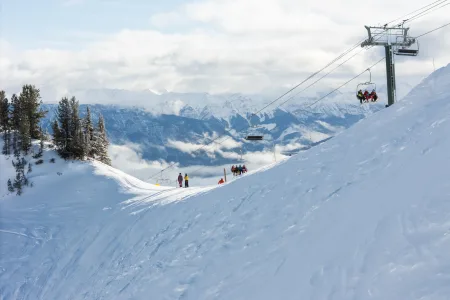
Skiers started arriving in the 20th century along with the first chairlifts, which were built in the 1940s and 50s, and today, Bormio is widely recognised as one of Italy’s premiere ski destinations. It’s a particular favourite with well-heeled Milanese wanting to make the most of their winter weekends, but also with international visitors from all over Europe and beyond. One of the big attractions is the Stelvio slope, which welcomes World Cup races every year, and will host the men’s Olympic alpine skiing events this February.

Bormio’s Olympic Events
Bormio has been chosen as the stage for the Winter Olympic equivalent of the 100m final, the men’s alpine skiing downhill race, on February 7th. The resort will also be hosting the other men’s alpine disciplines—the Team Combined, Super G, Giant Slalom and Slalom, on February 9th, 11th, 14th and 16th, respectively—all of which will be staged on the iconic Stelvio slope.

This piste, which is widely regarded as one of the most challenging and technical on the downhill World Cup circuit, is 3.4km long with a 1,023m vertical drop and a maximum gradient of 63 percent. Experienced skiers can ski themselves outside of competition times (it’s a black, obviously!), but it’s not for the faint-hearted.
In addition to these downhill races, Bormio will play host to the first ever uphill ski race to feature at the Winter Olympics, as Ski Mountaineering makes its Olympic debut at Milano Cortina on February 19th. SkiMo, as it’s known, involves participants racing uphill on touring skis equipped with climbing skins, before taking them off at the top and racing back down a banked slalom course. The men's and women's sprint finals take place on February 19th, and you can catch the mixed relay final on February 21st.

More than just the Sports
Of course, there’s far more to Bormio than just these thrilling Olympic contests. Locals have organised a whole series of events both before, during and after the Games, which celebrate the town’s rich cultural heritage, and its long links to sporting excellence.
Among these, highlights include the Olympic torch relay, which passes through town on January 31st; the SnowSound Project, a series of audiovisual installations and displays; and the excellent Oro Bianco, or “White Gold” exhibition, which opened on December 21st 2025 and runs through until March 30th 2026. This celebrates the local community’s Olympic spirit, by highlighting the lives and careers of notable athletes from Bormio—including the legendary Deborah Compagnoni, who won three alpine skiing gold medals at three separate Winter Olympics, in 1992, 1994 and 1998.

In addition, there are several long-standing events that take place in Bormio within the Olympic period. On February 13th, between the Super G and Giant Slalom races, locals will stage the Palio delle Contrade. This is Bormio’s answer to Siena’s world-famous Palio horseback race, in which champions from different areas of the town race each other not on horses, but on cross country skis.
On February 15th, there’s an even older tradition, which dates back to medieval times: the Fool’s Carnival. Traditionally, this saw a jester elected as the leader of the town for a week, giving him license to call out the folly of the regular Podestà, or magistrate, who sat at the head of the town council. Today the Podestà di Mat (or “Podesta of the Mad”) is elected in place of the Mayor for a day, not a week. But the tradition of highlighting complaints and amusing gossip from citizens persists—and everyone dresses up in medieval costume for the occasion.

Permanent Attractions
Of course, not everyone is going to be lucky enough to visit Bormio during the Games, or in the immediate aftermath. But there are plenty of reasons to pick this attractive northern Italian ski resort as the destination for your next skiing holiday anyway.
Chief among these are the thermal baths that first made Bormio famous. In addition to Pliny the Elder, Leonardo da Vinci and Giuseppe Garibaldi, Italy’s national hero, these have welcomed countless members of local and European royalty throughout the ages. Today, there are three official hot spring sites where visitors can take the waters. The Bagni Vecchi (“Old Baths”) have pools that date back to Roman times. The Bagni Nuovi (“New Baths”) are inside a stunning, purpose-built hotel just outside town that actually dates back to 1836. And last but not least, the Bormio Terme baths, in the centre of town, offer a more easily-accessible, modern alternative. All have their unique charms, and if you’ve got time, it’s worth visiting all three.

Bormio’s Centro Storico (“historic town centre”) is also well worth visiting in its own right. How many other ski resorts can boast of having 15th Century frescoes over the shop doorways on their main streets? Or more than one 13th century church, or multiple baroque palazzi? The architecture of the old town is testament to its centuries-old history, and rich cultural heritage. While much of it has been lovingly preserved, this isn’t a medival themepark or a heritage museum—what makes it truly special is that almost all of these historic buildings are still in use today.
Last but not least, Bormio is the administrative centre of the Stelvio National Park, one of the oldest in Italy, and among the most popular anywhere in the Alps. If you’re not the alpine skiing type, or fancy a slower sort of winter sports holiday, the park is paradise—with easy to follow walking and snow shoeing trails offering endless ways to escape into a wild, winter wonderland. From the hustle and bustle of Olympic racing to the quiet contemplation of the park or the baths, Bormio has something for every kind of winter holiday maker. And it doesn’t take long there to realise, this really is more than just a ski resort.
For more information about visiting Bormio, go to bormio.eu